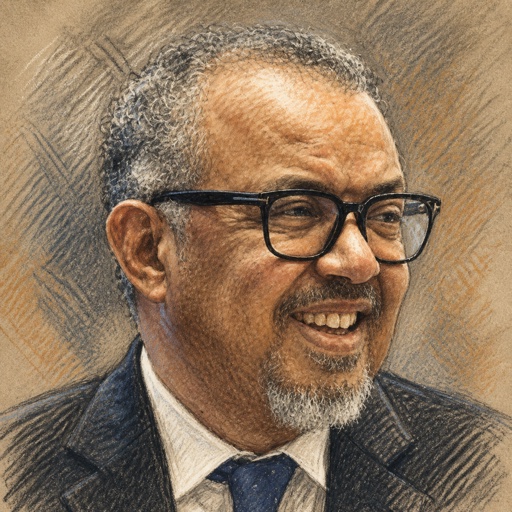
Tedros Adhanom Ghebreyesus
@DrTedros · Afrika
Tedros Adhanom Ghebreyesus patří mezi osobnosti, které Storyz World sleduje kvůli tématům vlády a veřejné správy v kapitole Afrika. Země, k níž se sledování vztahuje: Etiopie.
I was deeply honoured and humbled to receive the Order of #TimorLeste from President @JoseRamosHorta1, and accept it on behalf of all my @WHO colleagues and health workers around the world. Together, for #HealthForAll! #RC79 https://t.co/P2hkJdnML5
I met #India’s Health Minister @JPNadda and congratulated him on the country’s impressive health gains, particularly in maternal and child health and the fight against noncommunicable diseases. Through 160,000 Ayushman Arogya Mandirs, India is bringing screening for hypertension, diabetes and common cancers closer to communities, with referral pathways for care. India’s ASHA workers are another powerful example of health care reaching people where they are, supporting mothers and children from conception through adolescence. Together with expanded immunization and the rise in institutional deliveries from 78% to 93%, this is contributing to sustained declines in maternal and child mortality. We also discussed India’s determined efforts to #EndTB, strengthen regulation of medical products, and its important support for @WHO, including on traditional medicine and the ongoing negotiations on the Pathogen Access and Benefit Sharing system of the WHO Pandemic Agreement. #RC79
Over the past few days, I was in #TimorLeste for the @WHOSEARO Regional Committee. The health challenges before us are great, but so are our achievements, including the elimination of #trachoma as a public health problem across the entire region. But our work continues. I made four special requests to the region’s Health Ministers: Approve the next increase in @WHO assessed contributions at next year’s World Health Assembly. Support sustainable financing to build a WHO that is leaner, more efficient and focused on its core mandate. Keep WHO focused on the work that only WHO can do. Finalise negotiations on the Pathogen Access and Benefit Sharing annex, so the Pandemic Agreement can enter into force. There is no greater cause than the health and well-being of the people we serve. #RC79
Yesterday in Dili, @WHOSEARO Health Ministers, delegates and community members came together to Walk the Talk for #HealthForAll on the sidelines of #RC79. Health starts with the choices we make every day: being physically active, eating a healthy diet, and avoiding tobacco and use of alcohol. But health also depends on ensuring that everyone, everywhere, can access the care and services they need. As we walked to Cristo Rei, we renewed our commitment to both: healthier life styles and stronger health systems that leave no one behind. And there was no quiet finish. In true Timorese style, the morning wrapped up with Zumba and Poco-Poco, powered by the energy of local drum bands along the way. Thank you, #TimorLeste!
Congratulations, #Thailand, for eliminating #rubella: https://t.co/eZ3wIGp97h My thanks to all the health workers, volunteers, partners, communities and the government for decades of their commitment to protect children, women and families from vaccine-preventable diseases. https://t.co/bWHoM252zx
Investing in health workers delivers results and advances #HealthForAll. Across the WHO South-East Asia Region, the number of doctors, nurses and midwives relative to the population has increased by about 70% since 2014, and nearly all Member States now exceed WHO's health workforce threshold. At a Ministerial Roundtable during the @WHOSEARO Regional Committee, I congratulated Member States on their commitment to strengthening the health workforce and health systems, helping build healthier communities for all.
In every country in the @WHOSEARO Region, there are successes to celebrate and challenges to confront. I congratulate Bhutan, Maldives, Nepal and Timor-Leste on achieving disease elimination milestones. I also commend Bangladesh and Nepal for expanding HPV vaccination; India for its leadership in digital surveillance; Thailand for extending health coverage to stateless populations; DPR Korea and Sri Lanka for strengthening health security; and Myanmar for maintaining TB, HIV and hepatitis treatment in extremely challenging circumstances. As fiscal pressures grow and external financing becomes less certain, domestic investment in health is the most reliable path to universal health coverage. My three asks to the region's Health Ministers: 1. Invest in prevention: tobacco control, healthy diets, physical activity, and maternal and child health. 2. Invest in primary health care as the foundation of strong, equitable and sustainable health systems. 3. Invest in preparedness: surveillance, laboratories, emergency workforces, resilient health facilities and community readiness. @WHO remains fully committed to supporting every Member State in delivering on these priorities. #RC79
My congratulations to health workers, the government and communities in #Bhutan on becoming the first country in the @WHOSEARO region to eliminate dog-transmitted #rabies: https://t.co/pfARLvg3XP This is a historic achievement, and another step towards our goal to end human deaths from dog-transmitted rabies by 2030.
We are proud to partner with @EconforHealth in launching the Alcohol Tax Scoreboard, as part of the @WHO’s 3 by 35 initiative aiming to help countries accelerate implementation of health taxes. WHO-produced global price and tax data power the scorecard, providing evidence to advance policies that reduce the burden of cancer, heart disease, and diabetes through higher taxes on alcohol, tobacco, and sugary drinks. More about 3x35: https://t.co/cBL5XL4F6U. https://t.co/ckkuh2ElgL
In #Gaza, the humanitarian emergency continues to deepen, with public health risks growing as winter approaches and most people remain displaced in overcrowded tented camps. The already overwhelmed health system cannot withstand additional surges in disease and illness. The best medicine is peace.
I congratulate #TimorLeste government, health workers and communities on eliminating #trachoma. By combining sound planning, careful field investigation and modern surveillance, they have shown how science and strong health systems can protect people from preventable blindness: https://t.co/FPgkAWEJwF
The launch of a stockpile of #mpox vaccines is an important step towards ensuring that countries can access vaccines more quickly when they need them, saving lives and containing outbreaks before they spread further. My thanks to all partners involved. https://t.co/3FrwoU8wuc
In the fight against the #Ebola epidemic in the #DRC, we have made a lot of progress, but it’s not enough, and we still face major challenges. Earning and keeping community trust and community ownership are key to changing the trajectory of the epidemic. My latest update on the situation and the response ⬇️
Ghazal is one of five child patients from #Gaza whose medical evacuation to Belgium and Romania was supported by @WHO last Monday. Since October 2023, 13,285 patients, including 6285 children have been medically evacuated from Gaza to receive treatment abroad. We thank 🇧🇪 and 🇷🇴 for their continued solidarity with critical patients from Gaza. But as many more children and seriously ill patients need specailsed health care abroad, we continue to call for reopening of patient referral to health facilities in the West Bank, including East Jerusalem, and for more countries to accept patients for medical care not yet available in Gaza.
The #Ebola epidemic in the #DRC is already the second-largest on record, and the fastest-moving we have ever seen. Today we passed 6000 reported cases and almost 3000 deaths. The epidemic now affects 60 health zones across six provinces, making this an extremely complex emergency involving partners across the @UN system and beyond. @UNReliefChief Tom Fletcher and I briefed our Member States yesterday on our major concern that most deaths are still happening in communities rather than treatment centres and among people who were not known contacts. That means there are still chains of transmission we don’t know about. All aspects of the response have been scaled up and will continue to be expanded. We will end this epidemic. The question is how fast, and how many lives will be lost before we do. The longer it takes, the higher the cost in lives and resources. The Government-led plan for the next six months requires $1.3 billion. We ask all Member States to increase and accelerate their contributions.
Sad days for the @WHO family, with the sudden passing of Dr Vasee Moorthy. Vasee joined WHO in 2009 and made a major contribution to advancing the Organization’s work on clinical trials, especially in low- and middle-income countries. Most recently, he was leading the R&D Blueprint for Epidemics, which included advancing trials of vaccines and therapeutics for the current #Ebola epidemic. Vasee was undertaking this work with passion and commitment, bringing partners together to advance trials as fast as possible. The fact that we have three vaccines and three therapeutics now in trials is due in no small part to Vasee’s determination and energy. Beyond his professional accomplishments, Vasee will be remembered for his kindness, humility and collegial spirit. My deepest sympathies are with his family and with all WHO colleagues who knew him and worked with him.
Health threats do not respect borders. From disease outbreaks and humanitarian crises to climate-related shocks, countries are increasingly confronted with risks that no nation can tackle alone. At the first meeting of the States Parties Committee for implementation of the International Health Regulations (#IHR), I reiterated the importance of collective action to strengthen county abilities to prevent, detect and respond to public health threats while advancing global health security. This requires: - Country-level implementation to translate commitments into action - Measurable progress to drive accountability - Equity and solidarity to ensure no country is left behind - Interoperability and coordination to avoid fragmentation and maximize impact. Success in implementing the IHR will be measured not by commitments we make, but by stronger preparedness, surveillance, detection and response capacities in every country, making the world safer for all. My remarks: https://t.co/6PULUWFKP7
.@WHO stands with #Nepal. As communities face the devastating impacts of this disaster, we remain committed to supporting the country's response and recovery. Increased and sustained international support is urgently needed to address growing health needs. Learn how to help through the @WHOFoundation: https://t.co/ZEqjMac4SW https://t.co/3c5kza8AtA
I welcome the designation of the Global Harmonization Centre in the Republic of Korea as a new @WHO Collaborating Centre for health products regulatory system strengthening and training. By bringing together WHO’s global mandate and standards with Korea’s regulatory expertise, we can expand access to high-quality training, strengthen regulatory workforces worldwide, and help ensure that people everywhere have access to safe, effective and quality-assured medicines and vaccines. Strong regulatory systems are a cornerstone of resilient health systems and essential to achieving #HealthForAll.
.@WHO is scaling up its response to #Nepal's flood emergency further, releasing US$150,000 in immediate funding, with additional resources expected to be released as needs assessments continue. Within hours of the disaster striking, WHO deployed emergency supplies, including interagency emergency health supplies that could provide essential materials for nearly 10,000 people for 3 months, as well as tents, 10,000 masks, gloves and hand sanitizers. Our immediate priority is to support health services for the affected communities and restore disrupted health services. In addition, WHO is providing vital coordination among partners, surveillance and technical assistance to protect public health, all under the leadership of the Nepalese government. As the flood-affected communities face immense challenges, sustained support from all partners will be critical. WHO stands with the Government and people of Nepal at this difficult moment and remains ready to provide support based on the country's evolving needs.
Last week, @WHO supported the evacuation of 106 patients - including 19 children, along with 132 companions, from the Gaza Strip via the Rafah and Kerem Shalom crossings. Since October 2023, a total of 13,237 patients - 6276 of them being children - and 16,406 companions, have been evacuated. But thousands more still await medical evacuations. Medical evacuations give people in need of urgent care a chance of survival. To ensure timely treatment for patients, medical evacuations require sustained access through multiple crossing routes.
I congratulate #Uganda’s government, and all involved in the response, for passing the 42 day monitoring period with no cases of #Ebola. With a focus on preparedness, increased surveillance to find potential cases in health facilities and communities, and careful management of points of entry, countries can keep people and goods moving while ensuring people stay safe, or receive care if they are sick.
Responding to the flash flood and mudslide in bordering Nepal-China, @WHONepal has mobilized and dispatched essential emergency medical supplies, including medicines and multipurpose tents to support continued delivery of health services. Our office there is working closely with Nepalese authorities and other partners to identify further needs. I thank everyone involved in this response, especially those working on the ground despite the challenging situations.
Good call with the #Netherlands’ Minister of Foreign Trade and Development Cooperation @ministerBHOS, Sjoerd Sjoerdsma. I thanked him for the Netherlands’ continued support for @WHO’s work globally, including our response to the Ebola outbreak in the DRC. We discussed the evolving situation, which remains concerning. I underscored the importance of funding to sustain and scale the response as needs evolve. WHO remains at the forefront of the response, working alongside the government and partners through our extensive field presence, supporting surveillance, clinical care, safe and dignified burials, community engagement and other critical operations. Sustained international solidarity will be essential to bring this outbreak under control. We also discussed support for medical evacuations from Gaza, progress on the Pandemic Agreement, and the Netherlands’ strong leadership on sexual and reproductive health. I look forward to continuing our collaboration to protect public health and save lives.
My thoughts are with the people impacted by the flash flood and mudslide that hit the Nepal-China border this morning. @WHONepal has mobilized and dispatched essential emergency medical supplies, and provide field-level care to the affected communities. My greatest respect and gratitude for the selfless first responders doing the search and rescue and providing care during this difficult time.
Související články
- DR Congo Ebola Outbreak Reaches 60 Health Zones as Toll Rises to 2,786
- Nepal Flash Flood Kills Eight as 55 Security and Customs Staff Lose Contact
- Nepal Police Confirm 95 Dead in Bhotekoshi Flash Flood
- Nepal Deploys 7,415 Security Personnel for Bhotekoshi Flood Response
- Nepal Police Raise Rasuwa Flood Death Toll to 389
- Australia Announces A$5 Million for Nepal-China Flood Relief
- Bad Weather Pauses Nepal Flood Helicopter Operations on Fourth Day
- Nepal Flood Body-Recovery Count Rises to 669
- Nepal Says Rescuers Began Sending Air Into Trishuli 3A Tunnel
- Hundreds Attend Australia Vigils for Nepal and Tibet Flood Victims
- Nepal-Tibet Flood Toll Rises to 750 With 3,044 Missing
- Nepal Flood Body-Recovery Count Rises to 939 as Missing List Falls to 3,925