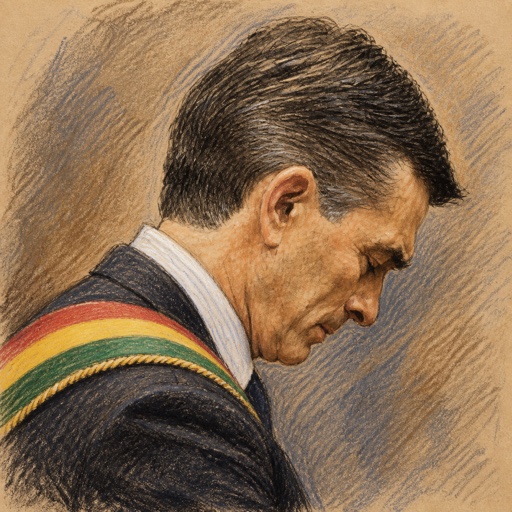
Rodrigo Paz
@Rodrigo_PazP · South America
Rodrigo Paz is followed by Storyz World for government and public service coverage connected to Bolivia in the South America chapter.
Ensuring that farm products reach the cities at the lowest possible cost is key to the daily lives of Bolivians. That is why we have initiated the process of securing US$55 million from FONPLATA to complete the remaining section of the Chiquitano Corridor. We are facilitating agricultural transport, reducing travel times, and ensuring greater road safety. More connectivity for our producers and more stability for the family food basket.
Translated from Spanish (Bolivia)This corridor also strengthens our eastern border. It is part of the route connecting us with Brazil, one of our main trading partners, facilitating bilateral trade throughout that region.
Translated from SpanishFrom San José de Chiquitos, I want to tell you that Bolivia has the route, has the plan, and has a Chiquitania that needs to be better connected with the rest of the country and the world. We formally announce the Bolivian state’s request to FONPLATA to finance the Chiquitano Corridor: 46.5 km between San José de Chiquitos and San Ignacio de Velasco. To connect here. To produce here. To grow here.
Translated from SpanishBolivia is producing again. Today, at the Gualberto Villarroel Refinery, we began reactivating our refining capacity. Our refineries can process 63,750 barrels per day, and today they process 24,067. That capacity must be put back to work for the country. We are going to produce more fuel in Bolivia, create Bolivian jobs, and reduce our dependence on finished fuel that we buy abroad. More Bolivian production, more jobs, and less dependence. We are building our future by producing here!
Translated from SpanishWe have arrived at the Gualberto Villarroel refinery. It is time to produce again! Today we began putting our industrial capacity back to work for Bolivia. Produce here. Create jobs here. Build our future here.
Translated from SpanishBolivia has the capacity. We have the refineries. We have our workers. It is time to produce again. Tomorrow, together with @YPFB_corp, we will take a new step to put our productive capacity at the service of Bolivia.
Translated from SpanishWe held a key meeting with Bo Mathiasen, Director of the Operations Division of @UNODC, to coordinate actions against organized crime and drug trafficking. His solid track record leading cross-border security strategies and alternative development in regions such as Colombia and the Southern Cone supports this strategic alliance to comprehensively combat illicit networks.
Translated from SpanishI express my deepest solidarity with the families of those who died, those who were injured, and all the residents affected by the explosions recorded at facilities of the Bolívar Regiment, in the municipality of Viacha. At times like this, the priority of the state must be to protect life, care for the victims, and support the families enduring hours of pain and uncertainty. From the very beginning, the Ministry of Defense activated emergency, security, evacuation, medical care, and area-protection mechanisms, in coordination with the competent institutions. I have also instructed that a thorough, technical, and transparent investigation into what happened be carried out. We must establish with absolute clarity the causes of this incident, verify compliance with safety protocols, and determine the responsibilities that apply. We will not speculate or jump to conclusions. We will act with seriousness, transparency, and responsibility.
Translated from SpanishBolivia presented its 2026–2030 National Health Plan in Brasília, a comprehensive reengineering of the health system led by Minister Marcela Flores Zambrana. The plan seeks to overcome the system’s historical fragmentation through five pillars: a new General Health Law, a Single Digital Medical Record interoperable across sectors, 24/7 care networks that resolve 80% of cases at the primary-care level, a merit-based health-care career, and a 50/50 co-financing model between the central government and municipalities, conditional on results such as vaccination coverage above 95%. By 2030, the goal is to reduce maternal mortality and consolidate a more equitable and sustainable system for Bolivian families. We congratulate our Health Minister, Marcela Flores, for representing Bolivia with this proposal before the region.
Translated from SpanishWe intervened in YPFB and the ANH: the fuel operator and the body that was supposed to oversee it. Quality controls were relaxed for years because of decisions that now raise well-founded suspicions of irregularities. This is not corrected with announcements; it is corrected by auditing, demanding complete information, and applying the Law to Combat Corruption. Two commissions will thoroughly review the management of both entities. Any finding involving possible liability will be sent to the Comptroller General’s Office and the Public Prosecutor’s Office, without exceptions. A necessary decision to end corruption, take control, and secure fuel for all Bolivians.
Translated from SpanishToday, from El Alto, we officially launched the Mass Titling Program so that thousands of Bolivian families can have the title to their home. This program is a concrete commitment by our government to legal certainty and the assets of Bolivian families. Granting title means giving certainty, dignity, and a future to those who built their home with great effort. This is how we understand 50/50: The state is built from the regions, together with municipal and departmental governments, and above all together with the people. We are making this right a reality.
Translated from SpanishIn Santa Cruz, we signed the National Agreement for the Complementary Infrastructure Program for Sports Facilities in Educational Units. For years, centralism kept the resources while the regions waited. That is over. This is also 50/50 in practice, not waiting for promises from the central government. With an investment of more than Bs. 288 million, we will bring 220 sports facilities to educational units in all 9 departments. We are not talking only about infrastructure. We are talking about spaces where our students will be able to play, train, compete and dream on equal terms, regardless of whether they live in the city or in the country’s most remote rural area. This is the management model Bolivia needs: technically prioritized projects, carried out transparently through the National Productive and Social Investment Fund (FPS), without fear of showing the numbers.
Translated from SpanishIn Santa Rosa del Sara, Santa Cruz, we began drilling the Junín-9 Dirigido well (JNN-9D), a new project by YPFB Chaco S.A., a subsidiary of @YPFBCorp, with an investment of US$6.4 million. The good news is that there is more gas here, there are more hydrocarbons. And that means greater production capacity for Chaco. With this well we are adding an additional 10%; if we move on to the next sector, we could reach 30% more. This means greater availability of gas to supply the country's homes and industries, strengthening our energy sovereignty. We are drilling directionally, taking advantage of a platform that already existed: less environmental impact, lower costs, the same commitment to the land. But this goes beyond a well. It is about giving Bolivia the certainty that, over the next 20, 30 and 40 years, we will have gas for our people and for export. Because it is not the size of the well that matters, but that Bolivia is getting back on its feet to reactivate its energy heart.
Translated from SpanishHeading to the Junín-9D well, together with Governor Jp Velasco, on our way to reactivate hydrocarbon exploitation and exploration in the homeland. Let’s move forward!
Translated from SpanishToday we met with @FAM_Bolivia1, ACOBOL, and the country's municipal association system to advance the 50/50 Agenda: the real balance of responsibilities, resources, and capacities between the national government and municipalities. This is not a negotiation over percentages; it is about building together a fairer, more efficient state that is closer to the people. There is no complete autonomy if it does not reach the territory where Bolivians live, work, and produce. That is why we established the technical working groups that will make this 50/50 possible, with fiscal co-responsibility and sustainability. In this way, we are putting into practice the 50/50 process that will strengthen autonomy, improve public management, and build lasting agreements among all levels of government.
Translated from SpanishWe are launching the National Program of 5,000 Scholarships @Google Career Launchpad: free international digital training for our young people, plus 100 full scholarships for teacher facilitators. Over 6 months, young people aged 18 and over, university and technical institute students, graduates, entrepreneurs and workers will be able to train for free in Artificial Intelligence, Cloud Computing, Cybersecurity, Data Analytics and other emerging fields, earning internationally recognized digital badges and discounts on @GoogleCloud certification. This is a partnership between the State, Google and our higher education institutions (CEUB, ANUP, ANDINACEP) to bring world-class training to young people throughout the country, with national coverage. This is how we prepare Bolivia for the jobs of the future: more innovation, more employability and more digital sovereignty. Bolivian talent has what it takes to compete in the world.
Translated from SpanishDuring the previous government, thousands of Bolivians saw their dollar savings trapped, while shortages worsened because of the decline in gas, the loss of reserves, and the squandering of our economic resources, with no plan or dates for savers. Today we are changing that: we are presenting a clear schedule with defined amounts, from $1.001 to more than $50.000, with staggered repayments between July 2026 and July 2027. We have already delivered about $8.5 million in the first phase and will add at least $48 million more in the second, on the way to returning all the retained deposits: about $933 million to individuals who entrusted their savings to Bolivia's financial system. It is a plan with dates and responsible officials.
Translated from Spanish